Sergio Nanni: (+39) 338 305 4973 | info@bestsardiniatrips.com

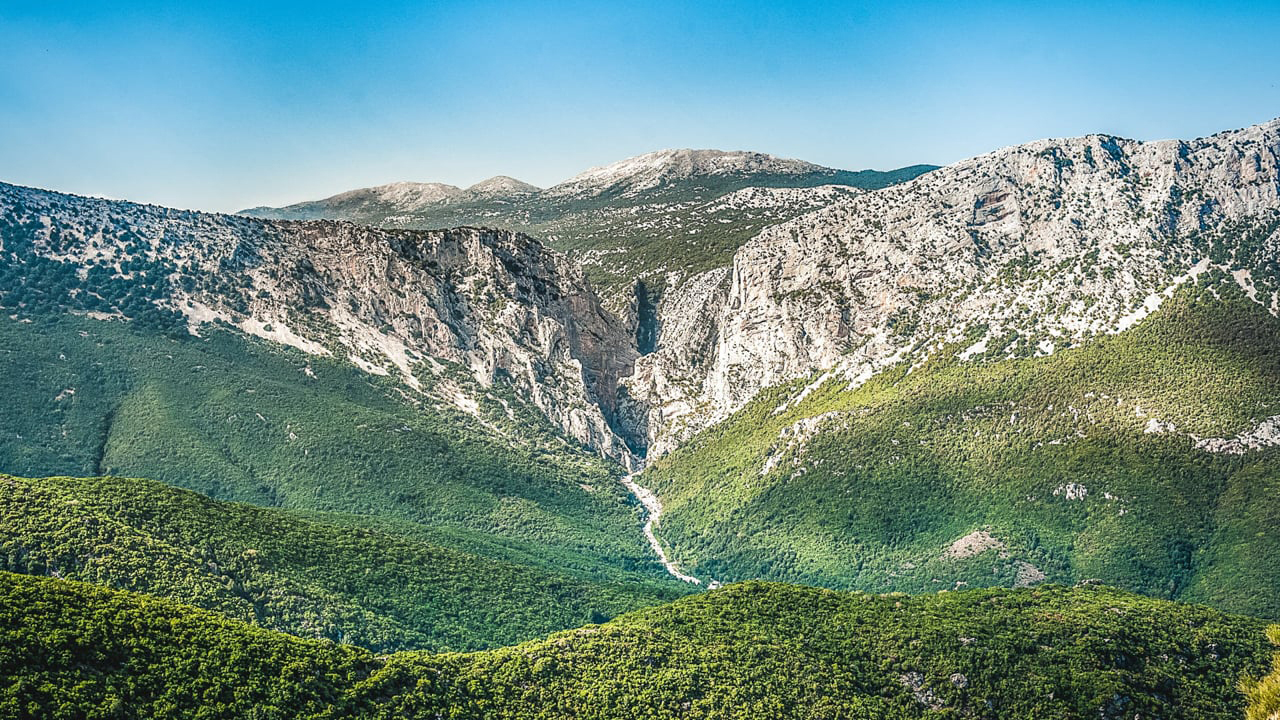
In the heart of the eastern Supramonte, between the villages of Urzulei and Orgosolo, lies one of the most extraordinary natural landscapes in Sardinia: the Su Gorropu Canyon, the deepest canyon in Italy. Limestone walls rising up to 500 metres, a cool and ancient microclimate, and an ecosystem where rare species survive that exist nowhere else on earth. It is no surprise that Su Gorropu has become one of the most famous destinations for hiking in Sardinia.
Where is Su Gorropu Canyon in Sardinia
The canyon opens along the course of the Flumineddu River, within the Gulf of Orosei and Gennargentu National Park, on the border between the municipalities of Urzulei and Orgosolo. It can be reached from several access points: from the Silana pass descending into the valley, or by following the riverbed upstream from below. Those travelling from Orosei or Cala Gonone can reach the canyon entrance by 4×4 to the refuge, then on foot for about 45 minutes. Its proximity to the Gulf of Orosei makes Su Gorropu an ideal destination to combine with coastal hikes in the Supramonte.
Why Su Gorropu is one of the most extraordinary ecosystems in Sardinia
The conditions inside the canyon are exceptional: near-constant shade, high humidity and large temperature variations between the walls and the valley floor. This microclimate has allowed the survival of relict species — plants and animals that disappeared elsewhere millennia ago — and has favoured the evolution of life forms unique to this canyon. This is why Su Gorropu is considered one of the most significant sites of natural interest in Sardinia and the entire Mediterranean.
The endemic flora of Su Gorropu
Aquilegia nuragica — the rarest flower of the canyon
Growing in the cracks of the limestone walls is the Gorropu Columbine (Aquilegia nuragica), an endemic flower with blue and whitish petals that exists nowhere else on earth. Its entire distribution covers just 50 m², between 620 and 680 metres in altitude, with only an estimated 40 mature individuals. It is listed among the IUCN’s 50 most endangered Mediterranean plant species: one of the most fragile botanical treasures in Europe.
Ribes sardoum and Tyrrhenian everlasting
The Sardinian currant (Ribes sardoum) is a relict plant that survived the ice ages, a living witness to a Mediterranean flora far older than the one we know today. The Tyrrhenian everlasting (Helichrysum microphyllum subsp. tyrrhenicum), a fragrant shrub typical of the arid rocky areas of Sardinia, adds colour and scent to the canyon trails. Along the Flumineddu River, the vegetation changes completely: oleanders, tamarisks and alders form a lush riparian belt that contrasts with the severity of the towering walls above.
The wildlife of Su Gorropu Canyon
During a hike or trekking in the Su Gorropu canyon it is possible to spot several iconic species of the Supramonte, some of which are extremely rare at a European level.
The Sardinian mouflon — the symbol of the Supramonte
Su Gorropu is one of the preferred habitats of the Sardinian mouflon (Ovis aries musimon), present in Sardinia for around 8,000 years and considered one of the oldest wild bovids in the world. The canyon walls shelter it from predators; the grassy gullies provide food. On silent mornings it is easy to spot males with their characteristic curved horns on the highest ledges.
Bonelli’s Eagle and raptors of the canyon
Soaring above Su Gorropu is Bonelli’s Eagle (Aquila fasciata), one of the rarest raptors in Europe. Sardinia hosts one of the most significant breeding populations in Europe. Alongside it, the Peregrine falcon, the common buzzard and, at dusk, the eagle owl patrol the skies above the gorge.
Endemic reptiles and amphibians of Sardinia
The reptile and amphibian fauna of Su Gorropu has an exceptionally high rate of endemism. The Tyrrhenian wall lizard (Podarcis tiliguerta) is exclusive to Sardinia and Corsica. The Sardinian cave salamander (Speleomantes flavus) is an endemic amphibian of Sardinia that has no lungs and breathes through its skin: it lives in the caves and damp crevices of the limestone, invisible to those who do not know where to look.
How to visit Su Gorropu responsibly
The fragility of this ecosystem is real. Species such as Aquilegia nuragica live in areas so restricted that just a few years of uncontrolled tourist pressure can put them at risk. Staying on the trails, not picking plants, not disturbing wildlife and following the guidance of local guides are not bureaucratic rules: they are the minimum required to avoid destroying what you have come to admire.
Guided hikes to Su Gorropu with Best Sardinia Trips
Want to explore Su Gorropu Canyon with an expert guide? Best Sardinia Trips organises guided hikes in the Supramonte with small groups and certified local guides. The Su Gorropu Canyon hiking tour departs from Orosei by 4×4, crosses the Supramonte landscape and descends into the heart of the gorge, with insights into the geology, flora and fauna of the canyon. It is suited to those with a good level of fitness who want to experience one of the most extraordinary places in Sardinia with the expertise of someone who has known it all their life.
Want to visit Su Gorropu Canyon with an expert guide?
Discover the guided hiking tour to Su Gorropu Canyon with Best Sardinia Trips →


